

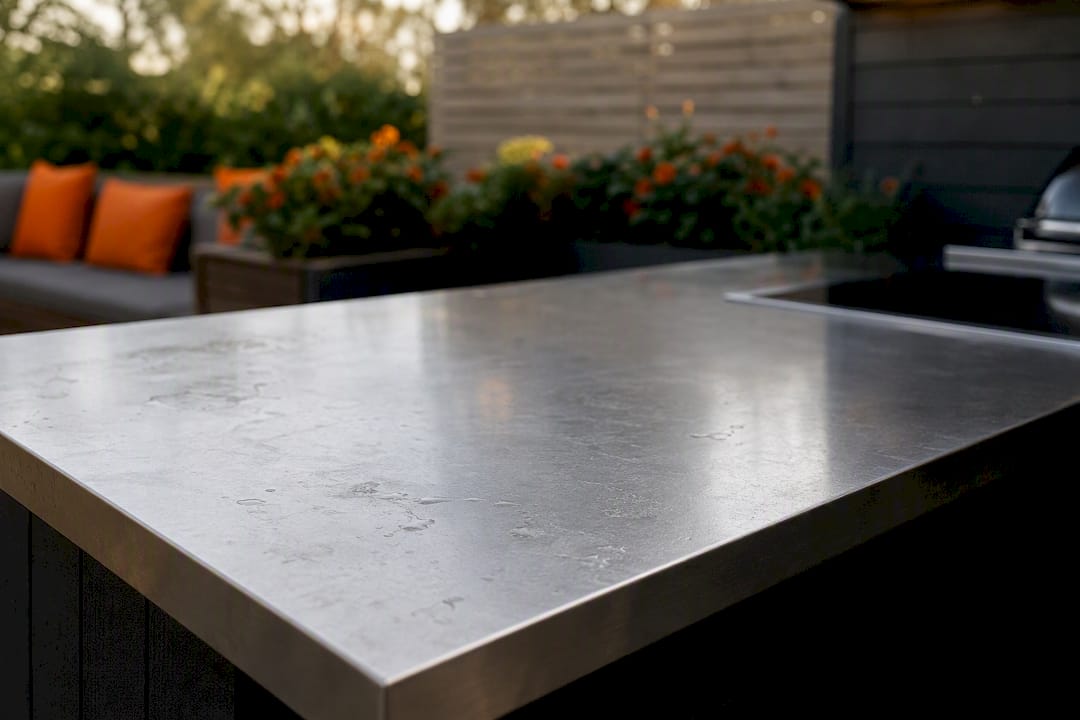
For most bespoke outdoor kitchens, outdoor-grade stainless steel is the right worktop choice, specified at 304-grade stainless steel as the commonly recommended minimum standard, upgraded to 316 in coastal or salt-heavy sites. It resists rust, shrugs off temperature swings near a grill, and holds its finish for decades. Galvanised steel earns its place only on tighter budgets or fully sheltered installations. Roostr specifies and fabricates to the correct grade for each site.
TL;DR:
- Stainless steel, especially grade 316, is the best material for outdoor worktops in coastal areas due to its resistance to salt corrosion and long lifespan of 25 to 30 years.
- Galvanised steel can be suitable for fully sheltered patios far from salt spray, but it requires regular inspection and maintenance to prevent rusting once the zinc coating is compromised.
- Granite outperforms quartz outdoors because it tolerates UV and moisture better, whereas quartz resin degrades under prolonged sunlight, leading to discoloration and cracking.
- Worktop selection should focus on site exposure, proximity to the heat source, maintenance willingness, and budget to ensure durability and optimal performance.
- Proper fabrication that integrates grade, finish, and structural support is critical, with fully coordinated steel systems avoiding issues common to improperly installed stone inserts.
Table of Contents
- Granite vs quartz worktop: which steel actually wins outdoors?
- Which steel grade resists corrosion best outdoors?
- How do you choose the right worktop material?
- Direct comparison of granite vs quartz for outdoor durability
- How do granite and quartz handle rain, UV and coastal salt air?
- Are granite or quartz suitable near a grill?
- Maintenance differences between granite and quartz outdoors
- Weight and support: what granite and quartz demand structurally
- Cost comparison: granite and quartz versus a steel worktop
- What Roostr’s fabrication experience actually tells us
- Ready to specify your outdoor kitchen worktop?
- Sources
Granite vs quartz worktop: which steel actually wins outdoors?
If you have landed here comparing “granite vs quartz worktop” options for an outdoor kitchen, the honest answer is neither belongs on your shortlist. Engineered quartz is built around a resin binder that breaks down under sustained UV exposure, which is why manufacturers routinely exclude outdoor installations from their warranties. Granite fares better outdoors than quartz, but it still needs annual resealing, rather than the two to three years typical of an indoor kitchen worktop.
That leaves the real decision for a custom outdoor build as one of steel grade, not stone type: stainless versus galvanised. Here is how they stack up at a glance.
- Corrosion resistance: stainless (especially 316) resists rust and pitting indefinitely in most UK gardens; galvanised offers good initial protection but degrades once the zinc coating is scratched or chipped.
- Maintenance frequency: stainless needs an occasional wipe and periodic polish; galvanised needs regular inspection for coating damage, particularly at cut edges and fixing points.
- Heat performance: both tolerate radiant heat from a grill without warping, but stainless keeps its surface finish better under repeated thermal cycling.
- Likely lifespan: quality stainless installations commonly reach 25 to 30 years; galvanised typically falls well short of that once damp or salt exposure sets in.
- Finish and aesthetic flexibility: stainless offers a wider range of brushed, matte and coloured finishes; galvanised is more utilitarian and harder to dress up.
Galvanised steel earns its keep on fully covered patios where rain and salt spray never reach the surface. Anywhere within reach of coastal air, 316 stainless is the only grade worth specifying. The checklist further down turns these trade-offs into a decision you can actually make on-site.
Which steel grade resists corrosion best outdoors?
The number that matters is chromium content. 304-grade stainless contains chromium and nickel in proportions that provide corrosion resistance, which forms a passive oxide layer that self-repairs when scratched. That is why 304 handles rain, frost and general weathering without complaint in an inland garden. 316 adds molybdenum to that mix, and molybdenum is specifically what resists chloride attack, the process by which salt air pits and discolours lesser steels.
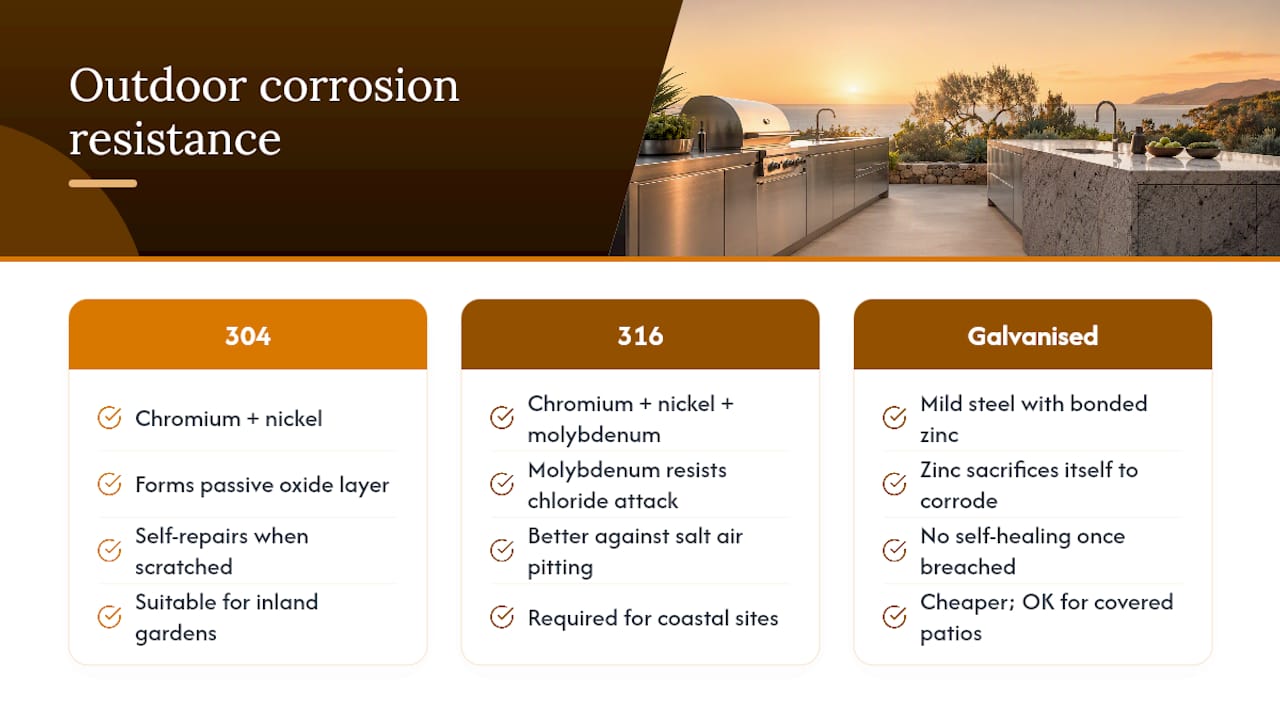
Galvanising works differently. A layer of zinc is bonded to mild steel and sacrifices itself to corrosion instead of the steel underneath. It is effective and genuinely cheaper, but the protection is only as good as the coating’s integrity. Once that zinc layer is scratched, drilled, or worn thin by prolonged wetness, the exposed steel beneath starts to rust in earnest, and there is no self-healing mechanism the way there is with stainless.
In practice, this breaks down by site type. A covered patio kitchen, shielded from direct rain and metres from any coastline, can reasonably run on galvanised panels for budget reasons. An inland garden with normal UK weather exposure calls for 304 stainless as a sensible default. A coastal terrace, or anywhere within a few miles of open water, needs 316 without exception, because salt-laden air will find every weak point in a lesser grade within a few seasons.
How do you choose the right worktop material?
Work through this in order, and you will land on the correct specification most of the time without needing to guess:
- Assess site exposure first. Is the kitchen coastal, inland, or fully covered? This single factor determines whether you need 316, 304, or can consider galvanised at all.
- Map proximity to the grill or Kamado. Worktop sections within close range of direct heat should always be stainless, regardless of budget elsewhere in the layout.
- Decide on finish priorities. Brushed, matte or coloured stainless finishes all perform differently under fingerprints and weathering, so pick based on how the kitchen will actually be used, not just how it photographs.
- Be honest about maintenance willingness. Stainless tolerates neglect far better than galvanised, which needs proactive coating checks.
- Set the budget band last, not first. Letting cost drive grade selection is how coastal kitchens end up with premature corrosion.
When you take that specification to a supplier, ask direct questions: what grade are they welding, not just quoting? What finish process do they use, and does it hold up to salt spray testing? What warranty backs the fabrication itself, separate from the appliances? Ask to see a completed installation in a comparable exposure, not just a studio sample.
Pro Tip: Ask to see the weld seams on a finished unit before you commission one. Poor welding traps moisture at the joint, and that is where corrosion starts on an otherwise correctly specified worktop, no matter how good the base grade is.
A red flag worth remembering: any supplier who cannot tell you the exact stainless grade they use, or who describes their steel simply as “marine grade” without naming 316, is guessing rather than specifying.
Direct comparison of granite vs quartz for outdoor durability
Set side by side, granite outperforms quartz outdoors on almost every measure that matters for a worktop exposed to the elements. Granite is a natural stone that tolerates temperature swings, UV and moisture reasonably well once properly sealed. Quartz, by contrast, is an engineered product bound together with resin, and that resin is the weak point the moment it goes outside.
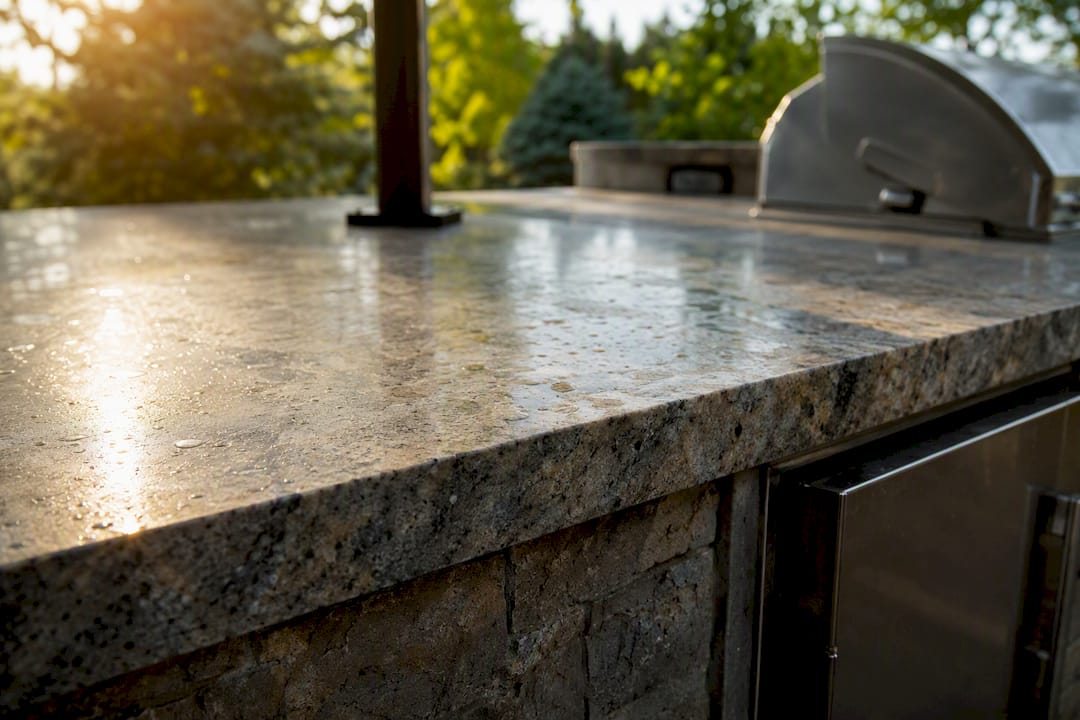
The practical difference shows up over a single UK summer. Granite left unsealed will absorb some moisture and eventually stain, but the stone itself does not structurally fail. Quartz worktops are often excluded from warranties for outdoor installations due to susceptibility to UV damage (https://meridiangranite.com/outdoor-kitchen-worktops-materials-that-survive-uk-weather/), because sustained sunlight degrades the resin binder, causing discolouration, fading and eventually surface cracking that no amount of cleaning will reverse.
Neither material, however, is the benchmark against which a custom steel-framed outdoor kitchen should be judged. Stone slabs of either kind add serious weight and typically get treated as a worktop insert within a steel or masonry frame, rather than as the entire build. For a modular kitchen built to Roostr’s specification, stainless steel remains the structural and surface material of choice, with stone reserved for those who specifically want a natural-material top and are prepared for the sealing regime that comes with it.
How do granite and quartz handle rain, UV and coastal salt air?
Rain is the easiest test, and both materials pass it reasonably well when sealed. Where they diverge sharply is UV and salt exposure over years rather than weeks.
Granite is mineral through and through, so ultraviolet light does not degrade its structure the way it does an engineered surface. What it does affect is the sealant applied over the stone, which is why outdoor granite typically requires more frequent resealing than indoor granite. Skip that maintenance and the porous stone beneath starts absorbing rainwater, staining, and in freeze-thaw conditions, that trapped moisture can expand and cause micro-cracking at the surface.
Quartz has no such sealing regime to fall back on, because the resin itself is the vulnerability. Continuous UV exposure breaks down the binder progressively, and in coastal locations the combination of salt-laden air and direct sun accelerates that process further. There is no maintenance routine that reverses resin degradation once it starts.
Steel, in contrast, does not carry either failure mode. Correctly graded stainless has no binder to break down and no porous surface to reseal. It simply resists the weather rather than needing ongoing protection from it, which is the core reason outdoor kitchen specialists treat stainless as the default material for exposed sites and reserve stone as a decorative option within a steel-supported build.
Are granite or quartz suitable near a grill?
Granite tolerates radiant heat from a grill or Kamado reasonably well, since natural stone has a high thermal mass and does not soften or scorch under normal cooking temperatures. Direct, sustained contact with very high heat can still cause thermal shock cracking in some granite types, particularly around seams, so most fabricators recommend a heat-resistant buffer strip between the cooking zone and the stone edge.
Quartz is the one that genuinely struggles here. The resin binder that makes it vulnerable to UV is equally vulnerable to heat. Sustained proximity to a hot grill surface can cause discolouration, warping at the edge, or even scorching of the resin, and this is one of the main reasons quartz sits outside most outdoor warranty terms in the first place.
Stainless steel, by comparison, is essentially unaffected by radiant heat from typical outdoor cooking equipment. It is the material grills and Kamado surrounds are usually built from anyway, which is why a steel worktop integrates far more naturally around the cooking zone than either stone option. If a design genuinely calls for a stone insert elsewhere on the layout, keeping it well clear of the grill footprint, and using a steel surround immediately around the appliance, gives the best of both without risking the stone.
Maintenance differences between granite and quartz outdoors
Granite’s maintenance schedule outdoors is annual resealing, plus routine cleaning with a pH-neutral stone cleaner to avoid stripping the sealant early. Miss that resealing window and the stone becomes progressively more porous, which shows up as darker staining around anywhere food or drink regularly touches the surface.
Quartz asks for less routine attention because there is no sealant to reapply, but that is a false economy. There is no maintenance task that halts UV-driven resin degradation once it has started, which means the material’s decline outdoors is essentially unmanaged. You are not maintaining quartz outdoors so much as watching a countdown you cannot pause.
Stainless steel sits in a different category entirely. Routine care is a wipe-down and an occasional stainless-specific polish to keep the brushed or matte finish looking sharp. There is no annual resealing task, no resin to monitor, and the material’s non-porous surface means it does not absorb the moisture or oils that drive staining in stone. For readers weighing genuine long-term upkeep against a busy household or a managed property portfolio, that gap in ongoing maintenance is one of the clearest arguments for building the worktop from steel rather than either stone option, and for treating stone purely as an occasional decorative insert if used at all.
Weight and support: what granite and quartz demand structurally
Granite and quartz are both heavy, and that has direct consequences for how an outdoor kitchen frame needs to be built. A granite worktop slab of typical outdoor thickness adds substantial dead weight to a cabinet run, which means the supporting frame beneath it needs to be engineered for that load from the outset rather than retrofitted afterwards. Quartz, being engineered rather than solid stone, tends to run slightly lighter than granite at comparable thickness, but it is still far heavier than a fabricated steel top.
That weight difference matters most at the design stage. A steel-framed modular kitchen built around a stone insert needs reinforced bracing under that section, additional fixing points, and often a masonry or concrete base rather than a purely steel substructure, which changes both the installation timeline and the groundwork required before the kitchen ever arrives on site.
A fully steel worktop avoids that structural overhead. Stainless tops are fabricated to sit directly on a modular steel frame without additional reinforcement, because the material itself carries a fraction of the weight per square metre that stone does. For a bespoke build where the frame, cabinets and worktop are specified together as one system, that lighter structural demand is one of the practical reasons steel worktops remain the more straightforward specification, particularly on raised decking, roof terraces or any site where ground-bearing capacity is limited.
Cost comparison: granite and quartz versus a steel worktop
Granite and quartz worktops both carry higher material costs than most people expect once outdoor-specific fabrication is factored in. Outdoor-rated sealants, reinforced edge detailing, and correctly specified marine-grade support structures beneath the stone all add to the installation bill beyond the price of the slab itself. Quartz sits in a similar cost bracket to granite at purchase, but because it is unsuitable for genuine outdoor use, any true cost comparison has to include the shortened lifespan and voided warranty as part of the real price.
Steel worktops price differently. Grade and finish are the main cost drivers, with 316 costing more upfront than 304, and specialised finishes adding further to the quote. But because a modular stainless system is designed and fabricated as one coordinated unit with the cabinet frame, installation tends to be more predictable than fitting a heavy stone slab onto a separately engineered support structure.
Looked at over the working life of the kitchen rather than the invoice on installation day, steel comes out ahead. A well-specified stainless installation reasonably runs 25 to 30 years with routine care, while quartz outdoors risks visible degradation within a few seasons of UV exposure. For anyone comparing granite vs quartz cost purely on the quote, it is worth remembering that the cheaper-looking option on paper is often the one that needs replacing first.
What Roostr’s fabrication experience actually tells us
Specifying grade is not a paperwork exercise. Roostr works through site exposure, appliance placement and finish preference on every custom build, then fabricates the steel worktop and frame as one coordinated system rather than bolting a top onto a generic cabinet. That is where a lot of quoted “stainless” kitchens quietly fall short: the grade might be right, but the welding, edge detail or support structure underneath is not designed for the material sitting on top of it.
Roostr’s Allure installation near The Hague shows what a properly specified stainless build looks like in a real garden setting, worktop and cabinetry designed together rather than assembled from separate parts. That kind of coordinated fabrication is a large part of why Roostr’s customers report a 9.7/10 satisfaction rating. If you want the fuller decision framework behind grade and finish choices, the worktop selection guide covers it in more depth than a single article can.
— Liam
Ready to specify your outdoor kitchen worktop?
Once you know the site exposure and grade you need, the next step is turning that specification into an actual layout. Roostr’s Floor system stainless steel gives you the modular base hardware to build a fully coordinated stainless kitchen rather than fitting a top onto a generic frame, and it is designed to pair directly with the cabinet range.

If a Kamado grill is part of the plan, the 70x70cm drawer cabinet and its 60x70cm counterpart both integrate directly with stainless worktop sections, alongside the door-fronted version for layouts that call for enclosed storage instead of a drawer. Choosing cabinet and worktop together from one supplier means the grade, finish and structural support are specified as a single system rather than pieced together from separate quotes, and it removes the guesswork around whether a stone insert will suit the frame beneath it.
Start by requesting a tailored design quote through Roostr’s configurator, or book a studio consultation to walk through grade and layout options with 3D visualisation before anything is fabricated.
Sources
Grade guidance, weathering behaviour and lifespan figures throughout this article draw on the outdoor kitchen buying guide, material weathering research, stainless steel remodelling advice, and lifespan and maintenance data. For layout and dimension planning once your worktop grade is settled, see Roostr’s dimensions guide.
- The ultimate guide to buying an outdoor kitchen in the UK
- Outdoor kitchen worktops: materials that survive UK weather
- Reasons to prefer stainless steel during outdoor kitchen remodelling
- How long do outdoor kitchens last? Lifespan & maintenance tips
Grid Access Decides Natural Gas or Propane for 1.7 Million UK Homes
Year round outdoor kitchen with a roof: UK ventilation, 3x4m costs